

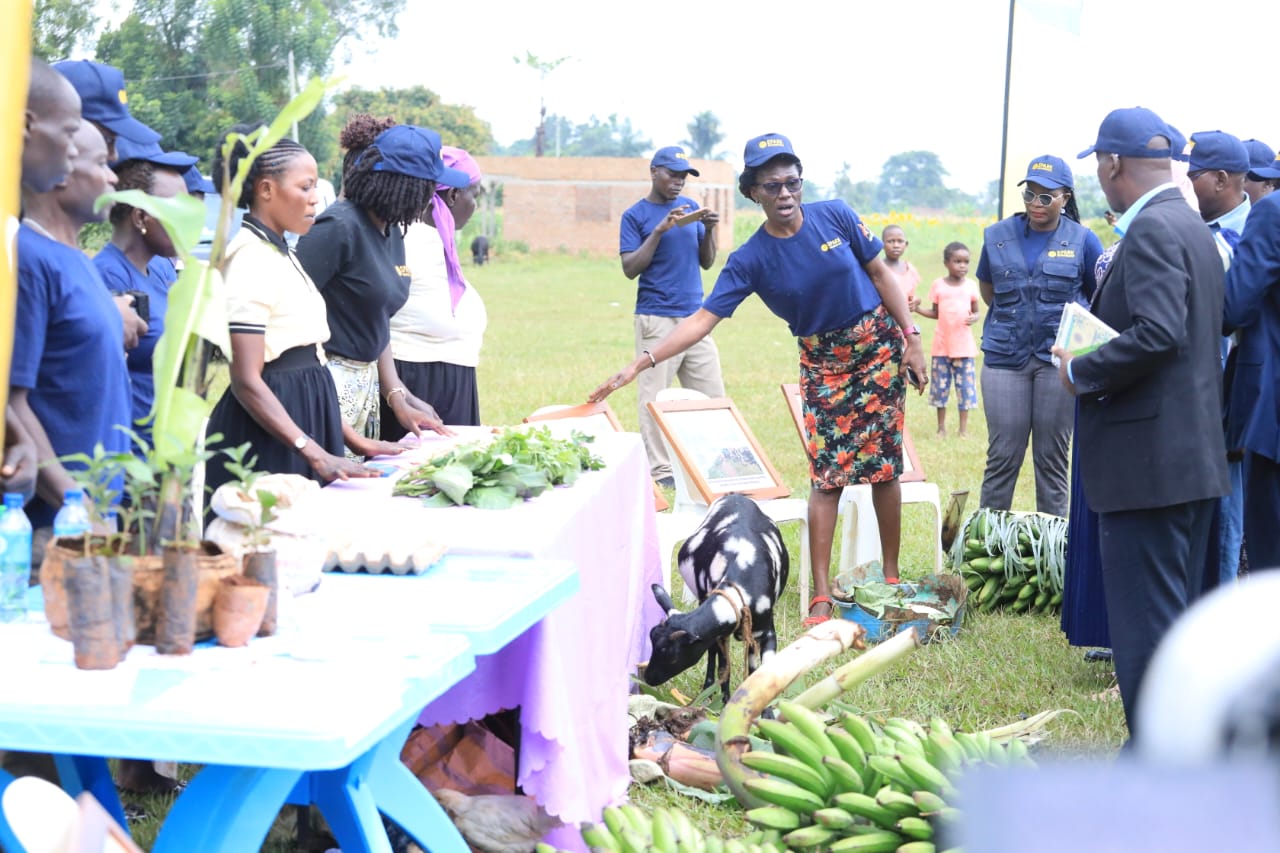
Spark Microgrants has rolled out a community-led financing model in eastern Uganda aimed at addressing persistent rural poverty, as local authorities seek alternatives to large, government-run programmes whose impact has increasingly come under scrutiny.
In Bulambuli District, on the slopes of Mount Elgon, the non-profit organisation is working with district authorities and civil society partners to support village savings and loan associations (VSLAs) that provide small, low-interest loans to households with limited access to formal banking services.
The model blends direct village-level cash transfers with structured community planning, giving residents greater control over how funds are invested—mainly in agriculture and small-scale businesses.
“The approach is simple,” said Grace Emma Akello, Spark Microgrants’ project coordinator. “Members pool their savings weekly, borrow from the fund to invest in farming or micro-businesses, and share profits at the end of a cycle.”
Women make up the majority of participants, a deliberate design choice by Spark Microgrants aimed at addressing gender-based exclusion from formal credit systems.
“The programme intentionally targets women, who are often left out of formal financial markets,” Akello told Nile Post.
District leaders say early results indicate improved household cash flow, stronger social cohesion, and increased cooperation at community level—prompting calls for the model to be adopted more widely.
“I want to appreciate Spark Microgrants for supporting our people over the last two years,” said Faheera Mpalanyi, Bulambuli’s Deputy Resident District Commissioner. “We have seen the value of this model, and we would like to adapt it for other government programmes.”
Mpalanyi also encouraged beneficiaries to expand participation.
“We are asking those already in the programme to engage others, so that people who have not yet benefited can also be included,” she said.
The pilot comes against a backdrop of persistent poverty nationwide. According to the latest National Household Survey, about 16 per cent of Uganda’s population—roughly seven million people—still live below the international poverty line, with poverty levels in rural areas nearly double those in urban centres.
Allen Makabayi, Spark Microgrants’ country director, said Bulambuli’s challenge lies not in food production but in income sustainability.
“Despite being a major food-producing district, Bulambuli has struggled to convert agricultural output into sustained household income,” Makabayi said.
“With the Spark model, we have seen women speak up and take on leadership roles in their communities. We work with community-based facilitators to ensure women’s voices are heard,” he added.
For policymakers, the key question remains whether community-driven financing models such as this can be scaled beyond pilot districts to play a more central role in Uganda’s broader poverty reduction strategy.
